

Bridging Bastrop 02
Look closer for three light pole flags and four text blocks: Bastrop Texas; Lost Pines; Bird City; 1923; One Hundred Years; Your Adventure Awaits; and “. . . a welcoming community with a compassion for our diversity, a tapestry of people, arts, and structures; preserving our history and character while embracing progress around our unique environment.” (The Bastrop Mission Statement)
The story:
The Old Iron Bridge
The Old Iron Bridge, sometimes referred to as the Colorado River Bridge, is a 1,285-foot (392 m)-long bridge with three steel truss spans and concrete piers that crosses the Colorado River as part of Loop 150 through Bastrop, Texas. The bridge is one of the earliest surviving uses of the Parker truss in Texas.
With automobiles becoming the dominant form of transportation in the United States after World War I, a new bridge was needed to handle the increasing traffic between Houston and Austin. The original estimate of the cost of the Old Iron Bridge was $40,000 and was partially financed by bonds issued by Bastrop County. The rest was paid for with federal funds disbursed by the Texas State Highway Department. Bids on the project were solicited and the Kansas City Bridge Co. was selected as contractor. The final cost of the bridge’s construction was $167,500. The bridge was completed in 1923 and opened for use in January 1924. The original bridge (pictured below) was sold and torn down in the early 1930s.
The bridge was listed in the National Register of Historic Places on July 19, 1990.
– credit Wikipedia
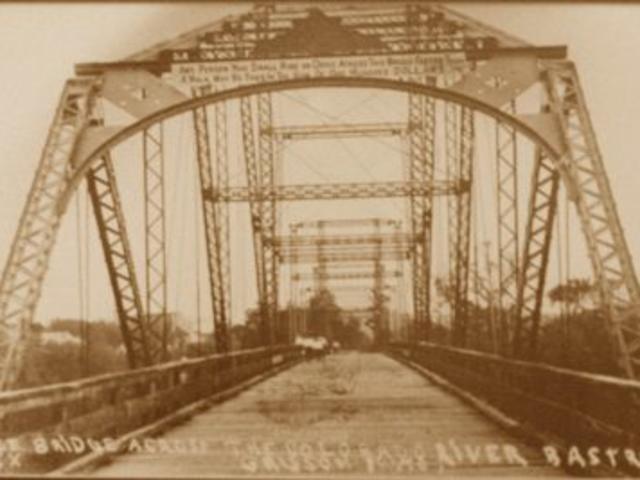
– photo credit visitbastrop.com
History of El Camino Real and The Old Iron Bridge (1890 – 1930s)
The original bridge, built in 1890, carried mostly horse and wagon traffic. El Camino Real (1700 to present) connected the United States-Mexico international border at the Río Grande to the eastern boundary of the Spanish province of Texas in Natchitoches Parish, Louisiana. The El Camino Real trail was shortened by the Old Iron Bridge construction. The bridge was a faster cross of the Colorado River than Nash’s Ferry, located at 1124 FM 969. The historical marker for Nash’s Ferry is at the back of the Colorado River RV park. As you are eastbound on 969, look for the over-sized cowboy statue seated on a split-rail fence. He will be waving a greeting with his right hand. The ferry accommodated passage over the Colorado River along what is now Farm to Market Road 969. Nash’s Ferry brought folks back to the north side of the Colorado River, who were westbound on El Camino Real after crossing to the south side in Bastrop. With construction of the first iron “hump-back” bridge in Bastrop, travelers along the stage coach trail could cross the Colorado once, moving goods from Austin to La Grange to the east.
– credit the artist, Tobin Bortner
The artwork:
This illustration was commissioned as a birthday gift for Bastrop’s City Manager.
Digital Print on Archival Matte – Original illustration done in graphite and prisma color
Artist: Tobin Bortner of Bastrop, Texas – drawing done in August of 2024 – © Look Closer Illustrations / Tobin Signs, LLC
Original Work
What you get:
$40 (36.95 + 3.05 tax)
11 x 14 Print Package with Authenticity Sheet
signed and numbered (run of 30)
Domestic Priority Mail $8 (Free shipping)
Bridging Bastrop 02 – 11×14 print
The Old Iron Bridge will open to foot traffic in 2027.
$40.00
What you get
for $60 (55.43 + 4.57 tax):
18 x 24 Print with Authenticity Sheet
shipping tube
signed and numbered within the (run of 30)
Domestic Priority Mail $10 (Free shipping)
Bridging Bastrop 02 – 18×24 poster
The Old Iron Bridge will open for foot traffic in 2017.
$60.00
 Look Closer Illustrations