Kerr Community Center 03
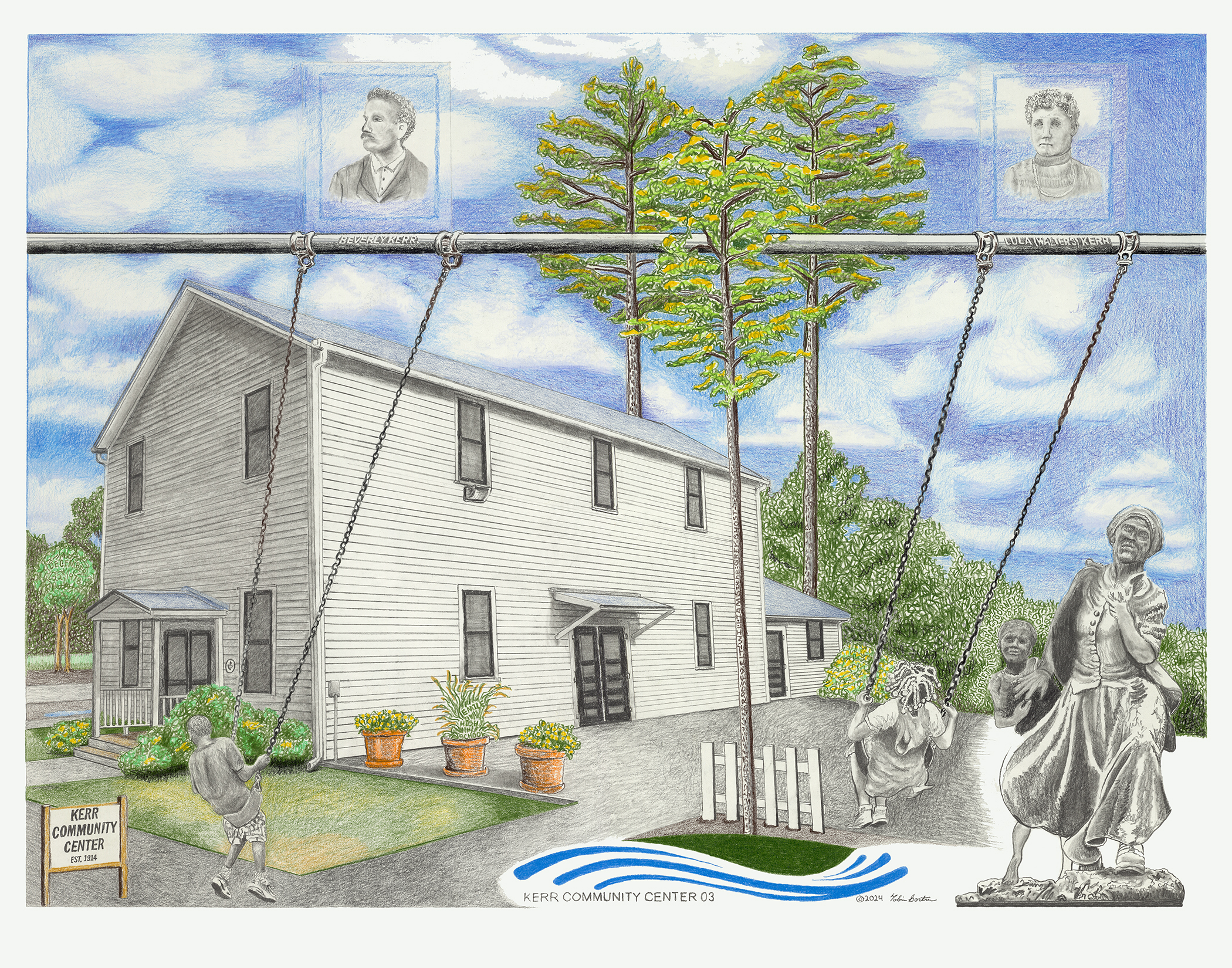
Look closer for: ‘Beverly Kerr’ and ‘Lula (Walters) Kerr’ (Builders); Roosevelt Williams, the “Grey Ghost” (Jazz Pianist); Emile High School (First Bastrop City School for African Americans); December 22, 1978 (National Register of Historic Places); Harriet Tubman – The Journey to Freedom (Sculpture by Wesley Wofford); and the City of Bastrop Logo.
The story:
The Kerr Community Center, originally called Kerr Hall, is a community center located in Bastrop, Texas, United States. The hall was a gathering spot for the African-American community of Bastrop during the time of racial segregation in the United States. The structure was listed in the National Register of Historic Places on December 22, 1978. Kerr Community Center is a two-story wood frame structure built in 1914 by Beverly and Lula Kerr on a lot directly behind their own home. The center hosted social events and artistic performances by black artists such as master blues pianist Roosevelt Williams, known to his fans as “Grey Ghost.” During World War II, the structure served as a USO post for the black soldiers assigned to Camp Swift.
– credit visitbastrop.com
The Kerrs of Bastrop, Texas
The history of Bastrop is very much a story of people who came for a better life than they knew elsewhere. In the 1830s, Anglo colonists heeded the call of Stephen F. Austin to move to this promising spot along the Colorado River. After Texas won its independence, others from the U.S. and Germany began to arrive. In the years following the Civil War, immigrants from the older Southern states, came to Texas for a new start.
Life in Texas following the War, was chaotic, for some, downright inhospitable. Much of Texas was particularly dangerous for Freedmen who lived or traveled there. The Texas economy, still greatly dependent on agriculture, did not enjoy the kind of boom experienced by the industrialized northern states. The emancipated slaves’ redefinition of economic and social relationships with whites brought severe troubles. Yet Bastrop continued to attract many different people to the area.
One of those who saw a future in Bastrop was Robert A. Kerr. He came here from Victoria sometime before 1880 with three younger brothers, John, Henry, and Beverly Kerr. The brothers made significant contributions to the Bastrop community, observable to this day.
Robert Kerr was the son of a white father and a black mother. He lived as an African American. Robert’s brothers, presumably the same ancestry grew up in Victoria, where they “…were given advantages in the white private schools…” Their father saw to it that they received ” …a very good background in the 3-Rs and music.”. There is some question, however, whether they lived their early lives as free citizens or as slaves.
A strong sense duty to the community, and their education enabled them to contribute much to Bastrop. They were set apart, not only from white settlers of the period but particularly newly liberated black Texans. 95% of the freed slaves were illiterate. Despite the difficulties of the times,
Robert Kerr was election to the Texas House of Representatives for the 17th Texas Legislature, which met in 1881. Only twelve African Americans served as legislators in the 1880s, three in the 1890s. Between 1898 and 1966, no black Texans served in the Texas Legislature.
At home, after his legislative service, Kerr played what was arguably an even more significant political role. In May of 1892, Robert Kerr was elected one of six of the inaugural group of Bastrop school trustees: He then helped lead efforts to adopt a local bond proposition, in June 1892, which enabled the purchase of land and construction of the Emile School, which also housed the first high school for black students in Bastrop. One of only 19 high schools for African Americans in all of Texas by 1900.
After the legislature, to earn a living, Robert worked as a barber and as a bookkeeper for the T.A. Hasler Store in downtown Bastrop, a major cotton buyer, buggy seller and purveyor of other goods.
Henry Kerr, like his older brother, is credited with founding the first public school for African American children under the Bastrop County school system, at the Cottonwood community, about 1880. Henry taught in Bastrop schools for fifty years. Henry Kerr died in 1952 at the age of 94.
Beverly Kerr, the youngest of the brothers, and a versatile musician, was a band teacher and the leader of Kerrs’ Orchestra. Beverly married Lula Walters, a college educated pianist, in 1889. She taught music in Bastrop area schools for over forty years.
The Kerr brothers and their spouses shared various aspects of their lives in Bastrop. They lived around the corner from one another, at Pine and Marion (MLK). It was the center of activity for African American Bastropians. Several older residents of Bastrop still remember the contributions the Kerrs, particularly Henry and Lula, made to so many young lives through their service in the schools.
As with all groups, however, events and the passage of time changed the make-up and dynamics of the Kerr family. Robert died in 1913. In the period following his death, Beverly and Lula Kerr emerged as Robert’s successors to represent the Kerr clan. They, too, were the kind of people who would make a difference in others’ lives.
The Kerrs arrived in Bastrop during a particularly dynamic time. In the 1880s, they witnessed dramatic growth in the county’s population; the building of our historic courthouse; the construction of the Bastrop Opera House; and the coming of the MKT railroad that connected Bastrop to the state’s and nation’s markets. Of enormous local significance, in 1889-90, the first bridge across the Colorado, at Bastrop, was constructed.
The early years for the Kerrs in Bastrop represent quite a period of achievement for the family. The legacy of the Kerr family as a force for good in our community, however, would continue to grow in the 20th century.
credit – Tom Scott, 2005, 2007
The Kerr Community Center demonstrates the determination, creativity and historical establishment of Bastrop. The past present and future of Bastrop is hopeful because of the Kerr Community Center.
credit – the artist
Derivative work: Kerr Community Center from kerrcommunitycenter_org;Kerr photos courtesy Bastrop County Historical Society; Harriet Tubman from allianceforTexasHistory_org – images_squarespace-cdn_com – Tubman+2; Kids on swings from Kerr Center Photo – Carol Lyons.
Digital Print on Archival Matte – Original llustration done with graphite and the following Prisma Colors: Cloud Blue; True Blue; Indigo Blue; Olive Green; True Green; Dark Umber; Sunburst Yellow; Yellow Ochre; Orange; Silver; and Black .
Artist: Tobin Bortner of Bastrop, Texas – Original drawing done in December of 2024 – © Look Closer Illustrations / Tobin Signs, LLC
What you get
for $40 (36.95 + 3.05 tax):
11 x 14 Print Package with Authenticity Sheet
signed and numbered (run of 40)
Domestic Priority Mail $8 (Free shipping)
Kerr Community Center 03 – 11×14 print
Bastrop’s past, present and future are hopeful because of the Kerr Community Center.
$40.00
What you get
for $60 (55.43 + 4.57 tax):
18 x 24 Print with Authenticity Sheet
shipping tube
signed and numbered (run of 40)
Domestic Priority Mail $10 (Free shipping)
Kerr Community Center 03 – 18×24 poster
Bastrop’s past, present and future are hopeful because of the Kerr Community Center.
$60.00
 Look Closer Illustrations