
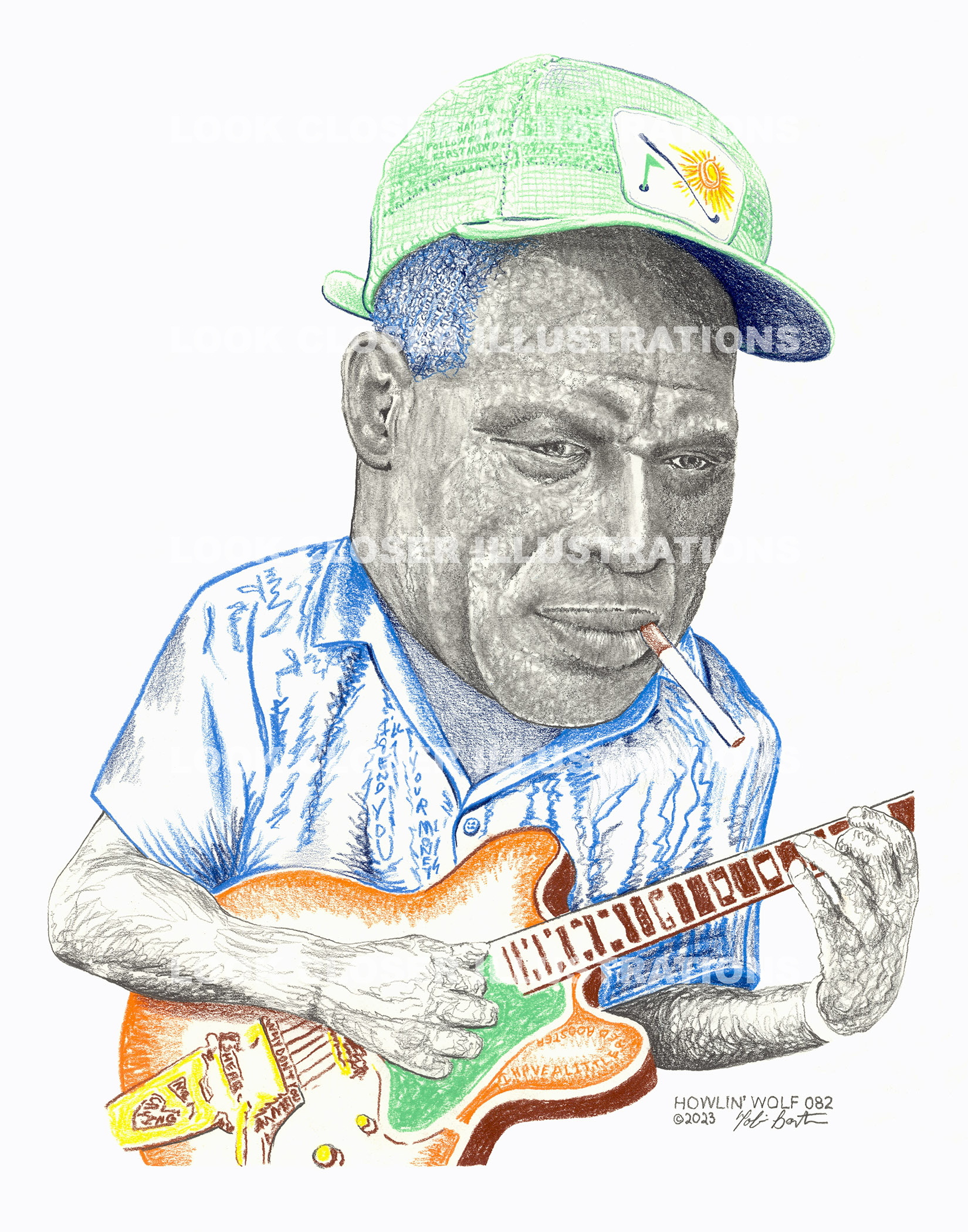
Howlin’ Wolf 082
Look closer for five lyrics: “If I ha’da followed my first mind.”(Killing Floor); “Why don’t you hear me cryin’?”(Smokestack Lightnin’); “I’ll send you your money.”(Baby How Long); “It could be a spoonful of diamonds.”(Spoonful); “I had a little red rooster.”(Little Red Rooster).
The Story:
Chester Arthur Burnett (06-10-1910 – 01-10-1976), known by his stage name Howlin’ Wolf, was an American blues singer and guitarist. At the forefront of transforming acoustic Delta blues into electric Chicago blues, Burnett, over a four-decade career, recorded blues, rhythm and blues, rock and roll, and psychedelic rock. He is regarded as one of the most influential blues musicians of all time.
Born into poverty in Mississippi as one of six kids, he went through a rough childhood where his mother kicked him out of her house, and he moved in with his great-uncle, who was particularly abusive. He then ran away to his father’s house where he finally found a happy family, and in the early 1930s became a protégé of legendary Delta blues guitarist and singer Charley Patton. He started a solo career in the Deep South, playing with other notable blues musicians of the era, and at the end of a decade had made a name for himself in the Mississippi Delta.
After legal issues and a rough experience serving in the Army, he moved to Chicago, Illinois. He first recorded in 1951 after 19-year-old Ike Turner heard him sing. He formed a band in Chicago. Five songs made the Billboard national R&B charts. He released albums in the ‘60s and ‘70s, and made television performances. His studio albums include The Howlin’ Wolf Album(1969), Message to the Young (1971), and The London Howlin’ Wolf Sessions (1971). He released his final album The Back Door Wolf in 1973. His last public performance was in November 1975 with blues legend B.B. King. His health declining, Burnett died in 1976. He was posthumously inducted in the Blues Hall of Fame in 1980, and the Rock and Roll Hall of Fame in 1991.
With a booming voice and imposing physical presence, he is one of the best-known Chicago blues artists. AllMusic has described him as “a primal, ferocious blues belter with a roster of classics rivaling anyone else, and a sandpaper growl of a voice that has been widely imitated”. The musician and critic Cub Koda noted, “no one could match Howlin’ Wolf for the singular ability to rock the house down to the foundation while simultaneously scaring its patrons out of its wits.” Producer Sam Phillips recalled, “When I heard Howlin’ Wolf, I said, ‘This is for me. This is where the soul of man never dies.'” Several of his songs, including “Smokestack Lightnin'”, “Killing Floor” and “Spoonful”, have become blues and blues rock standards. “Smokestack Lightnin'” was selected for a Grammy Hall of Fame Award in 1999, and three of his songs were listed by the Rock and Roll Hall of Fame in its “500 Songs That Shaped Rock and Roll”. In 2011, Rolling Stone magazine ranked him number 54 on its list of the “100 Greatest Artists of All Time”.
Early Life
Burnett was born at White Station, near West Point, Mississippi, to Gertrude Jones and Leon “Dock” Burnett. He later said his father was “Ethiopian”, his mom had Choctaw ancestry on her father’s side. Named for Chester A. Arthur, the 21st President of the U.S., the name “Howlin’ Wolf” originated from Burnett’s maternal grandfather. John Jones would admonish the boy for killing his grandmother’s chicks from reckless squeezing by warning him that wolves in the area would come and get him; the family would continue this by calling Burnett “the Wolf”. The blues historian Paul Oliver wrote that Burnett once claimed to have been given his nickname by his idol Jimmie Rodgers.
Burnett’s parents separated when he was one. Dock, worked seasonally as a farm laborer in the Mississippi Delta and moved there while Jones and Burnett moved to Monroe County.Jones and Burnett would sing together in the choir of the Life Boat Baptist Church near Gibson, Mississippi. Burnett later claimed he got his musical talent from her. Jones kicked Burnett out of the house during the winter when he was a child for unknown reasons. At the peak of his success, he returned from Chicago to see his mother in Mississippi and was driven to tears when she rebuffed him: she refused to take money offered by him, saying it was from his playing the “devil’s music”.
He moved in with his great-uncle Will Young, who had a large household and treated him badly. While in the Young household he worked almost all day and did not receive an education at the school house. When he was thirteen, he killed one of Young’s hogs in a rage after the hog had caused him to ruin his dress clothes; this enraged Young who then whipped him while chasing him on a mule. He then ran away and claimed to have walked 85 miles (137 km) barefoot to join his father, where he finally found a happy home with his father’s large family. During this era he went by the name “John D.” to dissociate himself from his past, a name by which several of his relatives would know him for the rest of his life.
He was 6 feet 3 inches tall and 300 pounds, which earned him nicknames “Big Foot Chester” and “Bull Cow” as a young man.
Musical Career
On January 15, 1928, at the age of 17, Burnett bought his first guitar. It was a date that Burnett reportedly never forgot until “the day he died”.
In 1930, Burnett met Charley Patton, the most popular bluesman in the Mississippi Delta at the time. He listened to Patton play nightly from outside a nearby juke joint. He remembered Patton playing “Pony Blues”, “High Water Everywhere”, “A Spoonful Blues”, and “Banty Rooster Blues”. As friends, soon Patton was teaching him guitar. Burnett recalled that “the first piece I ever played in my life was … a tune about hook up my pony and saddle up my black mare”—Patton’s “Pony Blues”. He learned about showmanship from Patton: “When he played his guitar, he would turn it over backwards and forwards, and throw it around over his shoulders, between his legs, throw it up in the sky”. Burnett would perform the guitar tricks he learned from Patton for the rest of his life. He played with Patton often in small Delta communities.
Burnett was influenced by other popular blues performers of the time, including the Mississippi Sheiks, Blind Lemon Jefferson, Ma Rainey, Lonnie Johnson, Tampa Red, Blind Blake, and Tommy Johnson. Two of the earliest songs he mastered were Jefferson’s “Match Box Blues” and Leroy Carr’s “How Long, How Long Blues”. The country singer Jimmie Rodgers was also an influence. Burnett tried to emulate Rodgers’s “blue yodel” but found that his efforts sounded more like a growl or a howl: “I couldn’t do no yodelin’, so I turned to howlin’. And it’s done me just fine”. His harmonica playing was modeled after that of Sonny Boy Williamson II, who taught him how to play when Burnett moved to Parkin, Arkansas, in 1933.
During the 1930s, Burnett performed in the South as a solo performer and with numerous blues musicians, including Floyd Jones, Johnny Shines, Honeyboy Edwards, Sonny Boy Williamson II, Robert Johnson, Robert Lockwood, Jr., Willie Brown, Son House and Willie Johnson. By the end of the decade, he was a fixture in clubs, with a harmonica and an early electric guitar. It was around this time that Burnett got into some legal trouble in Hughes, Arkansas: While he was in town, he tried to protect a female acquaintance from an angry boyfriend, and the two men fought, with Burnett killing the man with a hoe. What happened after this is a matter of dispute; Burnett either fled the area or did some jail time.
Howlin’ Wolf had a series of hit songs written by Willie Dixon, who’d been hired by the Chess brothers in 1950 as a songwriter, and during that period the competition between Muddy Waters and Howlin’ Wolf was intense. Dixon reported “Every once in a while Wolf would mention the fact that, ‘Hey man, you wrote that song for Muddy. How come you won’t write me one like that?’ But when you’d write for him he wouldn’t like it.” So, Dixon decided to use reverse psychology on him, by introducing the songs to Wolf as written for Muddy, thus inducing Wolf to accept them.
credit – Wikipedia
The artwork:
The first print of this illustration is available to support a non-profit fundraiser. Contact lisafromlsu@gmail.com.for details.
Digital Print on Archival Matte – Original in graphite and Prisma Colors: Indigo Blue; and True Blue for the blues; Terra Cotta and Orange to compliment the blues; True Green and Sunburst Yellow for the golf emblem on Howlin’ Wolf’s hat.
Artist: Tobin Bortner of Bastrop, Texas – drawing done in October of 2023 – ©Tobin Signs/Look Closer Illustrations
DERIVATIVE Work – photo credits: face from iconicimages_net – BW_HW002; guitar from Sandy Guy Shoenfeld – gettyimages-76039772-1024×1024.
What you get:
$40 (36.95 + 3.05 tax)
11 x 14 Print Package with Authenticity Sheet
signed and numbered (run of 20)
Domestic Priority Mail $8 (Free shipping)
Howlin’ Wolf 082
AKA “Bigfoot Chester” 6 foot 3 inches tall and 300 pounds.
$40.00
 Look Closer Illustrations